femdoming.com
femdoming.com
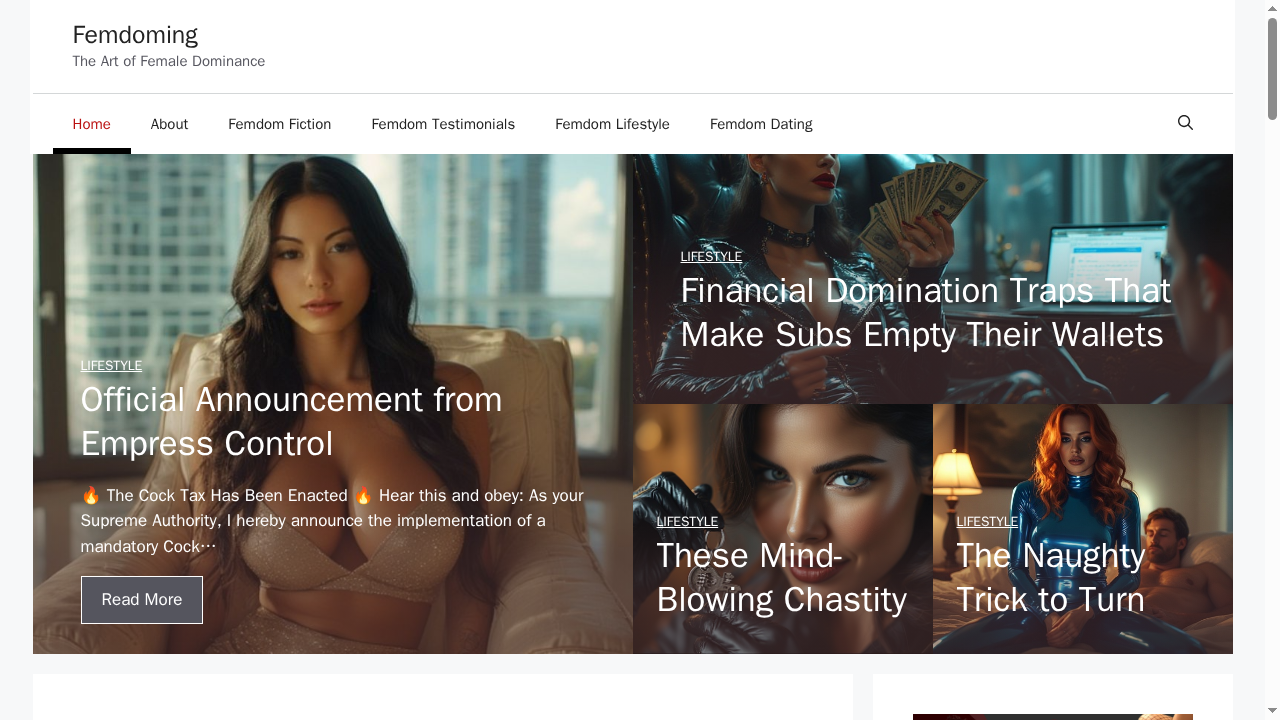
Femdoming.com operates as an SEO-driven blog focused on female dominance dynamics and Female-Led Relationships (FLR). It aggregates lifestyle tips, stories, and videos while heavily leveraging affiliate links to niche dating and training platforms. T...
Visit femdoming.comFemdoming.com operates as an SEO-driven blog focused on female dominance dynamics and Female-Led Relationships (FLR). It aggregates lifestyle tips, stories, and videos while heavily leveraging affiliate links to niche dating and training platforms. The site functions primarily as a content hub rather than a deep community or premium editorial property.
From an editorial standpoint, Femdoming.com presents itself as a resource for the art of female dominance, but its execution leans heavily toward affiliate marketing and SEO aggregation. The homepage promises 'expert tips' and 'captivating stories,' yet the content structure resembles a standard WordPress blog with thin depth—only 5 pages crawled against 69 discovered suggests significant archive or tag clutter. Outbound link analysis reveals a strategic focus on monetization, directing traffic to established niche players like slave-selection.com and matriarchmatch.com. While some articles offer coherent advice on foot worship and chastity, the presence of comment-heavy content on article pages (e.g., 'BDSM Barbie') indicates potential scraping or low engagement quality. It serves as a useful entry point for beginners but lacks the authority or community authenticity of top-tier niche media.
- Content style is generic blog posts with standard WordPress formatting
- Positioning as an 'expert' resource despite thin content depth
- Business model relies heavily on affiliate CPA links to dating/training sites
- Niche ecosystem role is traffic funnel rather than community hub
- Quality/authenticity appears mixed due to scraped comment data and low crawl ratio
- Meta descriptions are keyword-stuffed with terms like 'female dominance' and 'femdom'
- Site structure shows high internal linking but shallow indexability
- Search visibility likely driven by long-tail keywords rather than brand authority
- Content depth is limited with many pages potentially being thin archives